Decorative panels.
Connect the face, core and edge.
Start with the appearance you want, then identify the complete panel. PET, melamine, a wood-look pattern and a supplier color code each describe different parts of the choice.
Discuss your specification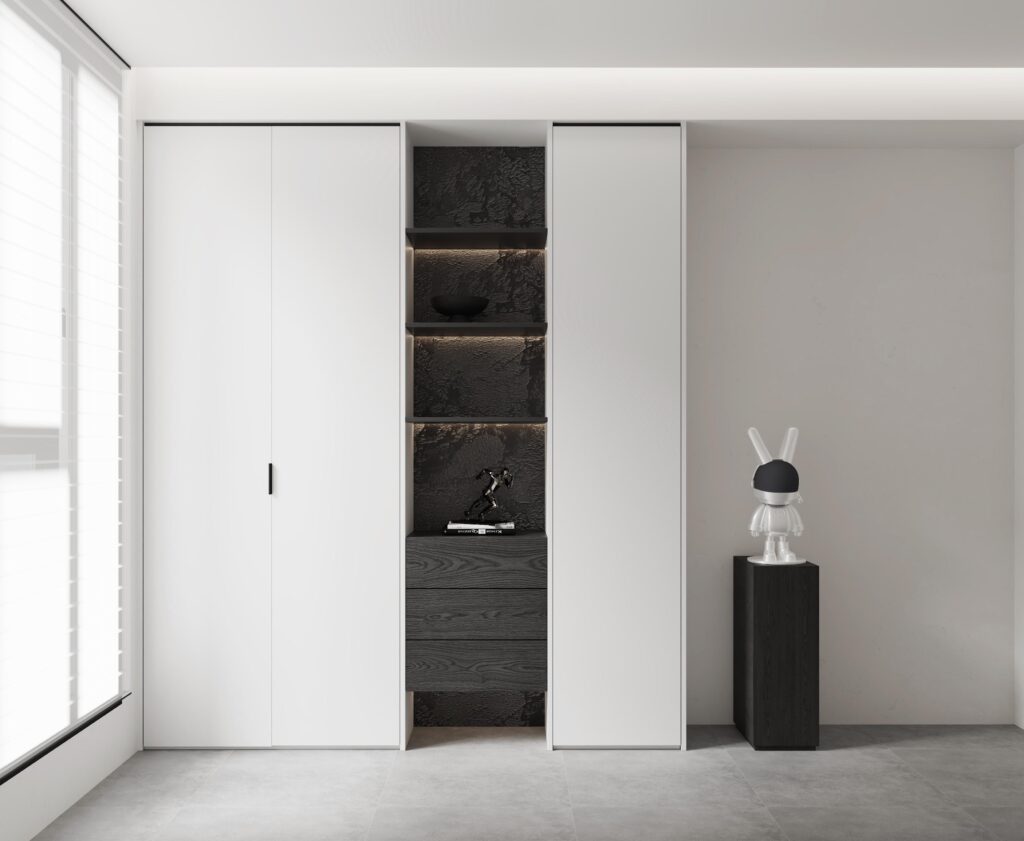
Choose where each surface belongs.
Here, large white fronts keep the outer cabinet quiet. Dark wood-grain drawer faces sit within an open display bay, while a textured backing adds depth behind the shelves. Each visual effect belongs to a different cabinet part.
- Main fronts
- Use a consistent plain color across the largest doors; the joints and opening detail define the elevation.
- Drawer faces
- Decide how the grain reads across the stack and against the adjacent door faces.
- Display backing
- Treat texture, lighting and the shelf-to-back junction as one detail.
Separate a material name from a visual effect.
A wood-look pattern describes appearance. PET describes a plastic decorative face used in the panel assembly. Melamine-faced describes a surface construction. None of these terms identifies every layer of the cabinet panel. Use the exact supplier reference to connect the face to its substrate, reverse face, edge and intended application.
The decorative face is identified as PET.
Film or face reference, substrate, thickness, reverse face, edge and permitted use.
The panel has a melamine-faced decorative surface.
Decor code, texture, substrate, thickness, reverse-face construction and edge.
The intended visual character.
The material that creates the appearance, pattern direction and complete panel construction.
A broad catalog description rather than a complete material specification.
Exact face material and product reference; core, edge, application and supporting documents.
Judge color, texture and pattern together.
A small swatch helps shortlist a color. A larger sample is more useful when texture, wood-grain direction or a repeating pattern is important. Look at the face and edge together, then place the sample beside the other finishes in the room. Record which pieces should run vertically or horizontally and where visual continuity matters.


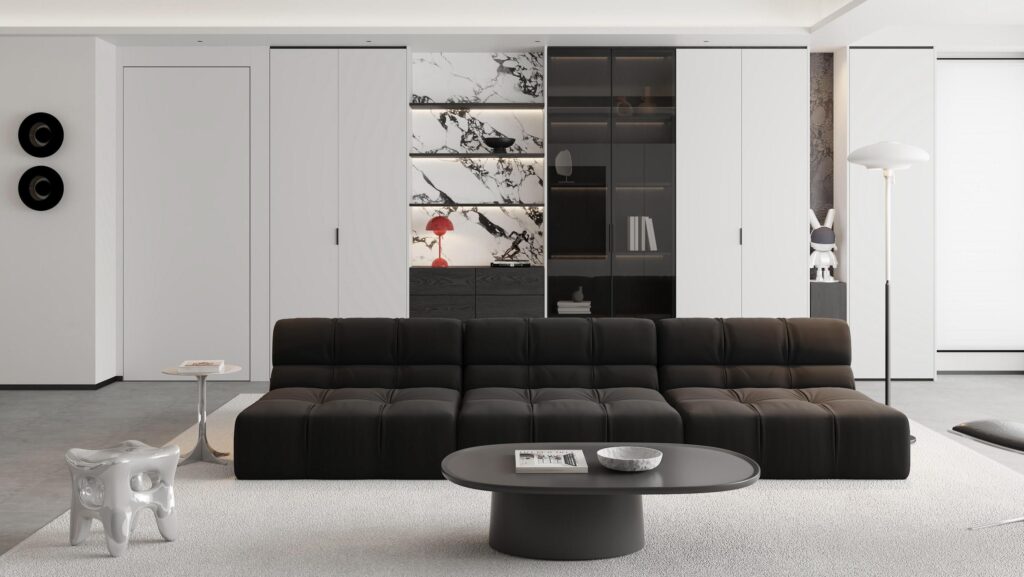
Visual combinations from the supplied cabinet catalog. The images show design intent; the exact face material, core, sheen and texture belong in the selected product specification.
- 01Start with an identifiable referenceRecord the supplier, product family, decor code and texture or sheen description. A color name on its own may not be unique.
- 02Review a representative areaChoose a sample large enough to show the texture, grain or pattern. Mark the intended orientation.
- 03Agree the edge relationshipDecide whether the edge should match, contrast or form part of a handle or profile. Confirm the selected edge with the actual panel.
Resolve the places where the face ends.
The edges, reverse face and opening details are part of the visible design. A slab door, an exposed end panel and a handleless front may need different details even when they share the same decor. Include the relevant sections in the drawing review so that the decorative choice can be checked against the proposed fabrication.
Matching, contrasting or a defined profile.
Edge material, color reference, geometry and junction with the face.
Same appearance or a different interior finish.
Reverse-face specification and which surfaces are visible when open.
Orientation and continuity across adjacent fronts.
Panel layout, sequence, visible joints and the approved reference.
Applied handle, edge pull or an integrated opening.
Door section, clearances and compatibility with the chosen panel.
The intended use of each cabinet.
Exposure, cleaning conditions and the selected product’s application information.
Compare complete specifications side by side.
Two proposals described as the same color can still contain different cores, thicknesses, textures and edge constructions. Ask each proposal to identify the same fields. Keep visual approval separate from performance documentation so that an attractive sample is not treated as proof of an untested property.
- Identity
- Manufacturer or supplier, product family and decor reference.
- Construction
- Face material, core, thickness, reverse face and edge.
- Appearance
- Color, texture, sheen, grain or pattern direction and approved sample ID.
- Use
- Cabinet components covered, fabrication details and applicable product documentation.
Before you choose.
Does PET mean that the whole board is plastic?
PET describes the decorative face in this panel description. The substrate is recorded separately, together with the reverse face, overall thickness and edge treatment.
Is a wood-look decorative panel the same as natural wood veneer?
No. A wood-look description states an appearance; natural wood veneer identifies a layer of wood. Check the face material when comparing references, especially when natural grain variation is part of the design.
Can I select one decor and use it in every room?
A shared decor can be the starting point for a whole-home palette. Review the complete panel and construction for each room and component, including any different exposure or cleaning conditions.
Does a matte surface automatically resist fingerprints or scratches?
Matte describes the appearance of reflected light. Any fingerprint, scratch or other performance claim needs information for the exact selected product and its stated conditions.
Bring your panel references into the brief.
Share the decor codes, reference images and rooms you are planning. Include any preferred substrate, edge detail or required product documentation.