Painted finishes.
Color with shape and depth.
A quiet matte wall, a curved feature island or a warmer dressing-room palette: painted cabinetry can give different shapes one continuous visual language. Develop the color together with the silhouette, sheen and opening detail.


Let the coating follow the form.
This charcoal kitchen pairs softly rounded front corners with warm contrasting reveals. Tall doors, upper cabinets and the island repeat the same curved outline, while straight drawer gaps keep the composition ordered.
- Round the outline
- Set the corner geometry and the points where curved faces return to straight runs. A fixed island end and an opening curved front need distinct construction details.
- Keep the reveal deliberate
- Use the gap or pull recess as part of the palette. Draw the reveal through drawer stacks and around returns so the line stays coherent.
- Balance sheen and contrast
- A dark face can sit beside reflective trim, glass or a brighter backsplash. Review the combination in the planned light instead of matching each finish in isolation.
Color, sheen and texture are separate decisions.
A color reference establishes a direction. Sheen describes the appearance of reflected light, while texture describes the surface character. The same color can read differently beside wood, stone and glass, or under a different light source. Review a physical sample in the intended setting and keep its reference in the project record.
Reference code, named color or supplied reference material.
The selected coating on its actual substrate, viewed beside adjacent finishes.
The intended matte, satin or gloss appearance.
Reflection under the room lighting and across both face and edge.
Smooth, textured or a specified decorative effect.
The visible and tactile character over an area large enough to judge.
Slab, framed, routed, fluted, curved or another defined profile.
Corners, recesses, exposed edges and transitions in the selected shape.
Review the coating with its substrate and profile.
“Painted” and “lacquered” are broad finish descriptions. They do not identify the full coating system or the construction beneath it. Name the substrate, door construction, coating reference and which faces are finished. Where a profile, frame or curve is part of the design, review a representative detail rather than approving color on a flat chip alone.
- 01Identify the buildRecord the door core or frame construction, overall dimensions and intended opening method.
- 02Define the coating scopeSpecify the face, reverse, edges and visible recesses, together with the intended color and sheen.
- 03Check the transitionsReview joints, profiles, adjoining panels, handles and integrated opening details in the drawings and sample.
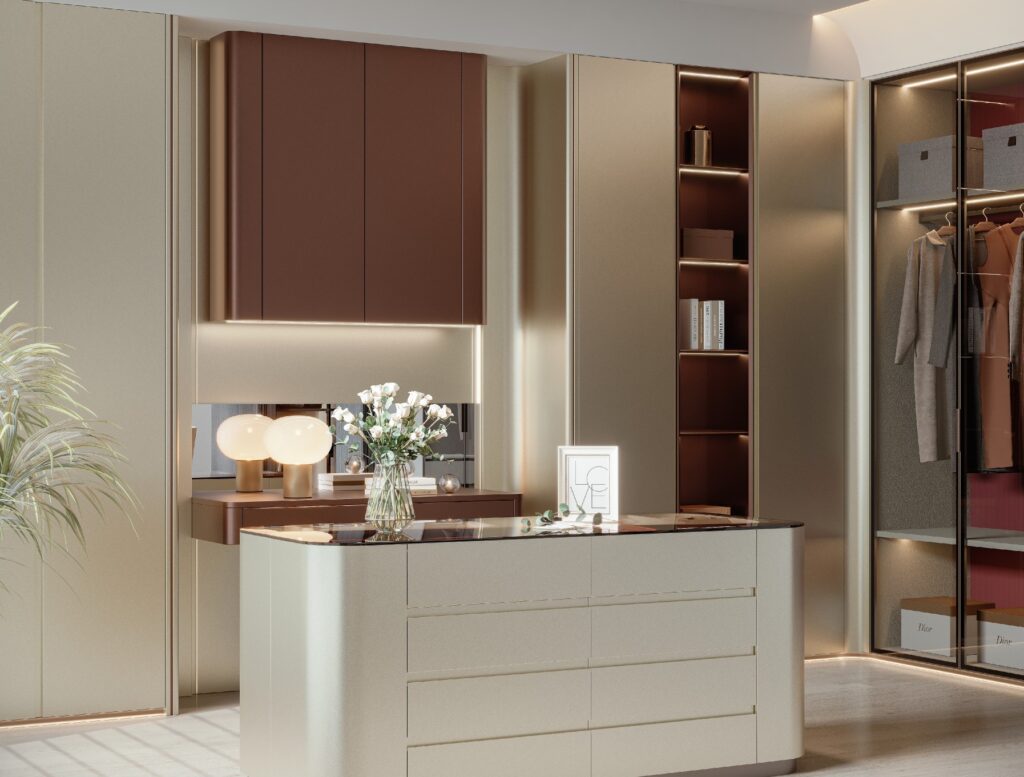
One palette, several kinds of storage.
A dressing table, storage island and wardrobe can share rounded edges without using one color everywhere. Here a warm brown zone frames the vanity, while a pale island face and softly reflective tall panels create a quieter background.
- Zone with color
- Use a stronger color for a dressing niche or feature cabinet, then repeat it in shelves or selected interiors to connect the room.
- Connect different components
- Schedule the face, end panel, top, toe kick and exposed drawer edge separately. Coordinate the palette across components with different geometry.
- Check a representative sample
- For a shaped painted door, include an actual corner or profile in the finish review. This makes edge coverage and reflection easier to assess than a flat color chip.
Keep one clear finish reference.
Attach the approved sample ID to the finish schedule and the relevant cabinet drawings. Record the date, decision maker and the components covered. If the color, sheen, substrate or profile changes, identify the change and confirm whether a new sample review is needed.
- Sample reference
- An identifiable physical sample or agreed sample record.
- Finish description
- Color, sheen, surface character and coating reference.
- Application
- The door, panel, edge and reverse-face conditions covered by the approval.
- Adjacent materials
- The other approved finishes used to review the palette.
Before you choose.
Can I choose a painted finish from a screen image?
Use an image to communicate the direction. Confirm the final appearance with a physical sample, because lighting, photography and displays can change how color and sheen appear.
Do “painted” and “lacquered” identify the coating chemistry?
These terms alone do not identify a complete coating system. Request the specific product or finish description and the information applicable to its intended use.
Can one color be used on every door shape?
Include the proposed shapes in the review. A flat front, a framed door and a routed profile create different details for coating and sample approval. Compatibility is confirmed for the selected construction.
Will a painted finish have a universal durability or care rating?
Use the care instructions and supporting information for the selected finish. Do not infer scratch, moisture, chemical or heat performance from a color name, sheen or the word lacquer.
Define the finish you want to achieve.
Include a palette, door style and reference images in your project brief. State which details should be resolved through a physical sample review.